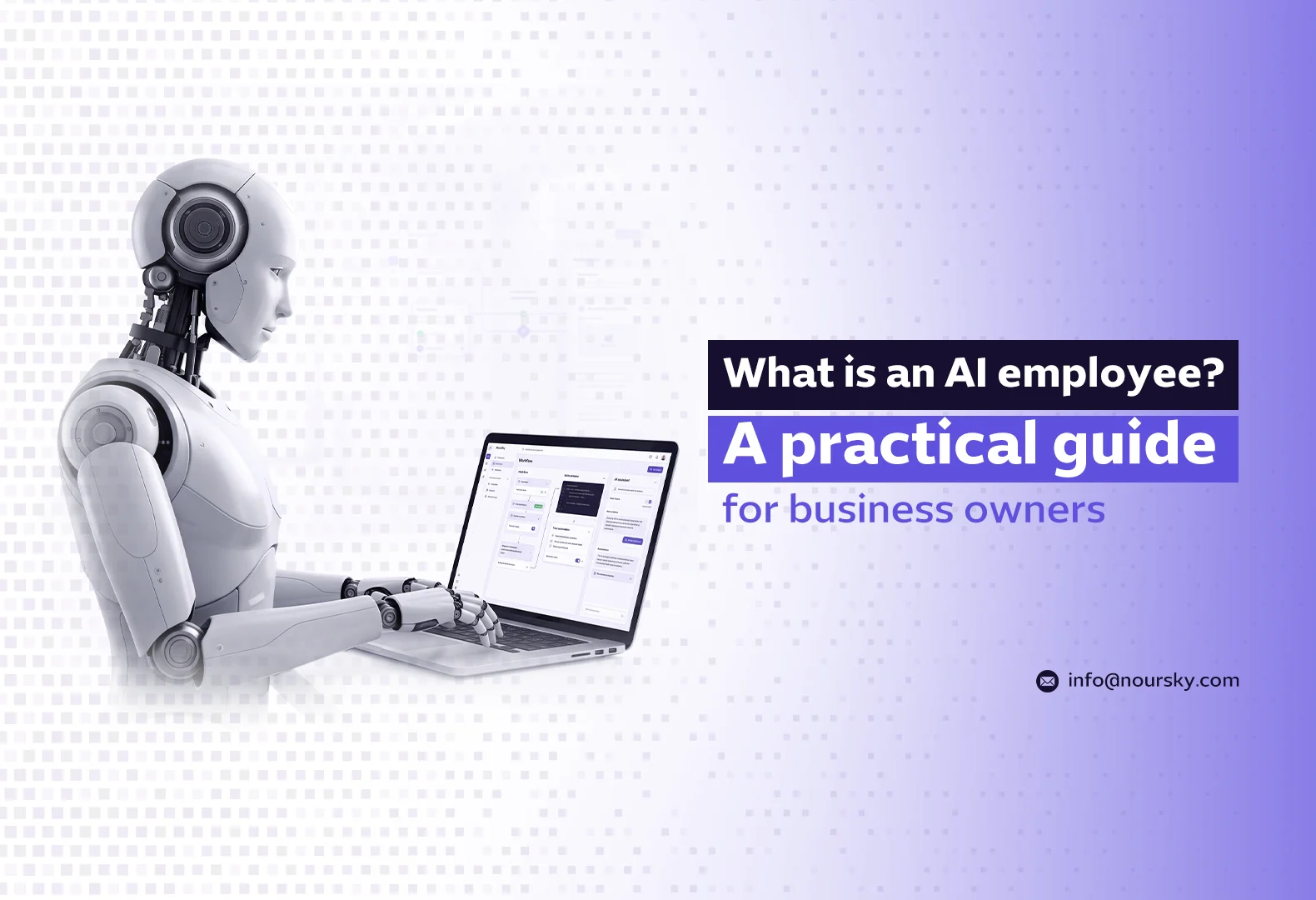
An AI employee for business is a system that receives customer messages on WhatsApp and other channels, understands the question in the customer’s own words, answers from your company’s data, qualifies the lead, books the next step and records it in your CRM. When a conversation goes beyond what it was built for, it hands over to a person.
This guide is written for owners and sales managers in Saudi Arabia, the UAE and the wider Gulf whose enquiries arrive faster than the team can answer them. It defines the term without the hype, shows where it stops being useful, and explains what it takes to run one properly. If you already know you want one, see the NourSky AI Employee.
What exactly is an AI employee for business?
“AI employee” is a job description, not a technology. It describes an AI agent that is given a defined role inside your business, usually the first line of sales or customer service, and is measured the way you would measure a person in that seat: did the customer get a correct answer, was the lead qualified, was the next step booked, and is it all written down?
Three things separate it from a generic AI chat tool:
- It works from your data, not the open internet. Services, prices you have published, policies, locations, working hours, and the questions your customers actually ask.
- It has a job with an end state. Not “chat”, but “get this enquiry to a booked viewing, a scheduled consultation, or a clear handoff”.
- It writes to your systems. Every conversation leaves a record in the CRM: who the customer is, what they want, what stage they are at, and what was promised.
How is an AI employee different from a chatbot or an auto-reply?
| Auto-reply | Traditional WhatsApp bot | AI employee | |
|---|---|---|---|
| How it replies | One fixed message | Menus and buttons | Understands free-text questions and answers them |
| Understanding | None | Only what matches a menu option | Different phrasings of the same question |
| Source of answers | A text you wrote once | A decision tree built by hand | Your company’s services, policies and FAQs |
| Qualification | No | Partly, through scripted questions | Asks what your team needs and assesses intent |
| Booking and follow-up | No | Limited | Books the next step and logs it |
| CRM | No | Sometimes | Core part of the build |
| Handoff to a human | No | When the user leaves the menu | By rules you define: complaints, special requests, ready-to-buy customers |
A menu bot is fine when every question is predictable. An auto-reply is fine for telling people you will get back to them. An AI employee is for the business that wants the message to become a booking or a sale without waiting for the next working day.
What does an AI employee actually do during a conversation?
Take a simplified example from a real estate office in Riyadh (the details are illustrative):
Customer: Hi, do you have 3-bedroom apartments for rent in north Riyadh?
AI employee: Welcome. Yes, we have options in north Riyadh. To shortlist the right ones, what’s your approximate annual budget, and when do you need to move?
Customer: Mid-range budget, within two months.
AI employee: Thanks. Two listings match. Shall I send photos and details? I can also book a viewing with one of our consultants tomorrow.
In four messages, it did the work of a sales assistant:
- Replied instantly, at any hour.
- Qualified the lead: property type, area, budget, timing.
- Moved toward a booking, a specific next step with a time.
- Logged the customer, their requirements and their stage in the CRM pipeline, so the consultant starts from context instead of from zero.
What should an AI employee never do?
A properly built AI employee is designed not to:
- Invent answers your data does not cover. The right behaviour is “Let me connect you with a colleague”, not a confident guess.
- Negotiate price or grant discounts outside written policy.
- Handle sensitive or angry complaints alone. These go to a person immediately.
- Replace a sales process you don’t have. If your stages are unclear, automation reproduces the confusion faster.
Why do so many AI agent projects fail?
Gartner predicted in June 2025 that over 40% of agentic AI projects will be canceled by the end of 2027, due to escalating costs, unclear business value or inadequate risk controls. It also estimated that only about 130 of the thousands of vendors claiming agentic capabilities offer the real thing; the rest practise what Gartner calls “agent washing”, rebranding existing assistants, RPA and chatbots.
Anushree Verma, Senior Director Analyst at Gartner, put it bluntly:
“Most agentic AI projects right now are early stage experiments or proof of concepts that are mostly driven by hype and are often misapplied.”
The same research firm is also bullish on the right use cases. In March 2025 Gartner predicted that by 2029 agentic AI will autonomously resolve 80% of common customer service issues without human intervention, leading to a 30% reduction in operational costs.
The difference between the projects that survive and the ones that get canceled usually comes down to three decisions made before the build:
- A measurable target from day one: first-response time, booked appointments, or the share of enquiries that get followed up.
- Real data, not marketing copy: your customers’ actual questions and your team’s actual answers.
- Clear handoff rules: when the AI stops, who it hands to, and how that person is notified.
Do customers accept talking to AI?
Not unconditionally, and it would be dishonest to pretend otherwise. In a Gartner survey of 5,728 customers conducted in December 2023, 64% said they would prefer companies didn’t use AI for customer service, and the top concern was that it would become harder to reach a person. Keith McIntosh, Senior Principal, Research at Gartner, said:
“Customers must know the AI-infused journey will deliver better solutions and seamless guidance, including connecting them to a person when necessary.”
A later Gartner survey of 3,566 customers (February–March 2026) found that 87% say access to a human agent is essential when companies use GenAI for customer service.
The lesson for a business owner is practical: an AI employee succeeds when it removes waiting, not when it removes people. Build the route to a human first, and say clearly that the customer is talking to an AI assistant. We cover disclosure in detail (in Arabic) in هل يعرف العميل أنه يكلّم ذكاءً اصطناعياً؟
Is an AI employee allowed on the WhatsApp Business API?
Yes, for serving your own customers. In October 2025 WhatsApp changed its Business Solution terms to bar general-purpose AI assistants (the kind whose main product is the chatbot itself) from the platform, effective January 15, 2026. Meta clarified to TechCrunch that “this move doesn’t affect businesses that are using AI to serve customers on WhatsApp”, giving the example of a travel company running a customer-service bot.
WhatsApp’s Business Messaging Policy adds a condition that matters for design: you may use automation when responding during the 24-hour window, “but must also have available prompt, clear, and direct escalation paths”. In other words, the human handoff is not a nice-to-have. It is part of the rules.
Does your business need an AI employee?
If you answer yes to three or more of these, you are likely losing enquiries to response time:
- Do enquiries arrive outside working hours or at weekends?
- Are more than half of incoming questions repeats in different words (price, availability, location, requirements)?
- Does response time slip at peak hours because the team is busy?
- Can you not say how many enquiries last month went unanswered or unfollowed?
- Does customer tracking depend on someone’s memory or a spreadsheet updated late?
To put a number on it, try the lost-leads calculator. And if your market is Arabic-speaking, read Arabic Dialects and AI Agents: Why Gulf Customers Abandon Most Bots before choosing a vendor.
How does NourSky build an AI employee?
NourSky builds AI employees around how your business sells, not from a template:
- Discovery session: the most common questions, your sales stages, and what your team needs from each customer.
- Build on your data: services, policies, service areas and FAQs.
- CRM connection: every customer enters the pipeline with their stage and details. If you need a CRM, see CRM built around how your team sells.
- Handoff rules: we agree with you when a conversation moves to a person.
- Testing and review: we read real conversations and refine the answers.
See an AI employee answer your own customers’ questions
Book a live demo. We test the AI employee on real questions from your business, and you see how it qualifies a customer and books the next step.
FAQ
Is an AI employee the same as a WhatsApp chatbot?
No. A traditional chatbot runs on pre-built menus. An AI employee understands free-text questions, answers from your company’s data, qualifies the customer and logs them in your CRM, and hands over to a person by rules you set.
Will an AI employee replace my sales team?
No. It takes the first reply, repeated questions, qualification and booking, and hands your team customers who are ready to talk. Negotiation, complaints and complex deals stay with people.
What happens when a customer asks something the AI doesn’t know?
A correct build stops it from guessing. It says so politely and hands the conversation to the right person, following rules you define in advance, which WhatsApp’s policy also expects.
Sources
- Gartner: Over 40% of Agentic AI Projects Will Be Canceled by End of 2027 (2025)
- Gartner: Agentic AI Will Autonomously Resolve 80% of Common Customer Service Issues by 2029 (2025)
- Gartner: 64% of Customers Would Prefer That Companies Didn’t Use AI for Customer Service (2024)
- Gartner: 87% of Customers Say Companies Using GenAI Must Provide Access to a Human Agent (2026)
- TechCrunch: WhatsApp changes its terms to bar general-purpose chatbots (2025)
- WhatsApp Business Messaging Policy