A multi-agent workflow splits one operational job across several AI agents, each with a narrow role, tools and instructions, coordinated by an orchestrator. It pays off when a task splits into independent parts that run in parallel. When steps depend tightly on each other, a single agent or fixed workflow is usually cheaper and more reliable.
This guide is for operations leads, COOs and founders in Saudi Arabia and the UAE who are being pitched “AI agent teams” and want to know what is real. If you would rather scope a specific process with us, see NourSky AI Solutions.
What is a multi-agent workflow, exactly?
Start with Anthropic’s distinction, from its December 2024 engineering guide Building Effective Agents:
- “Workflows are systems where LLMs and tools are orchestrated through predefined code paths.”
- “Agents are systems where LLMs dynamically direct their own processes and tool usage, maintaining control over how they accomplish tasks.”
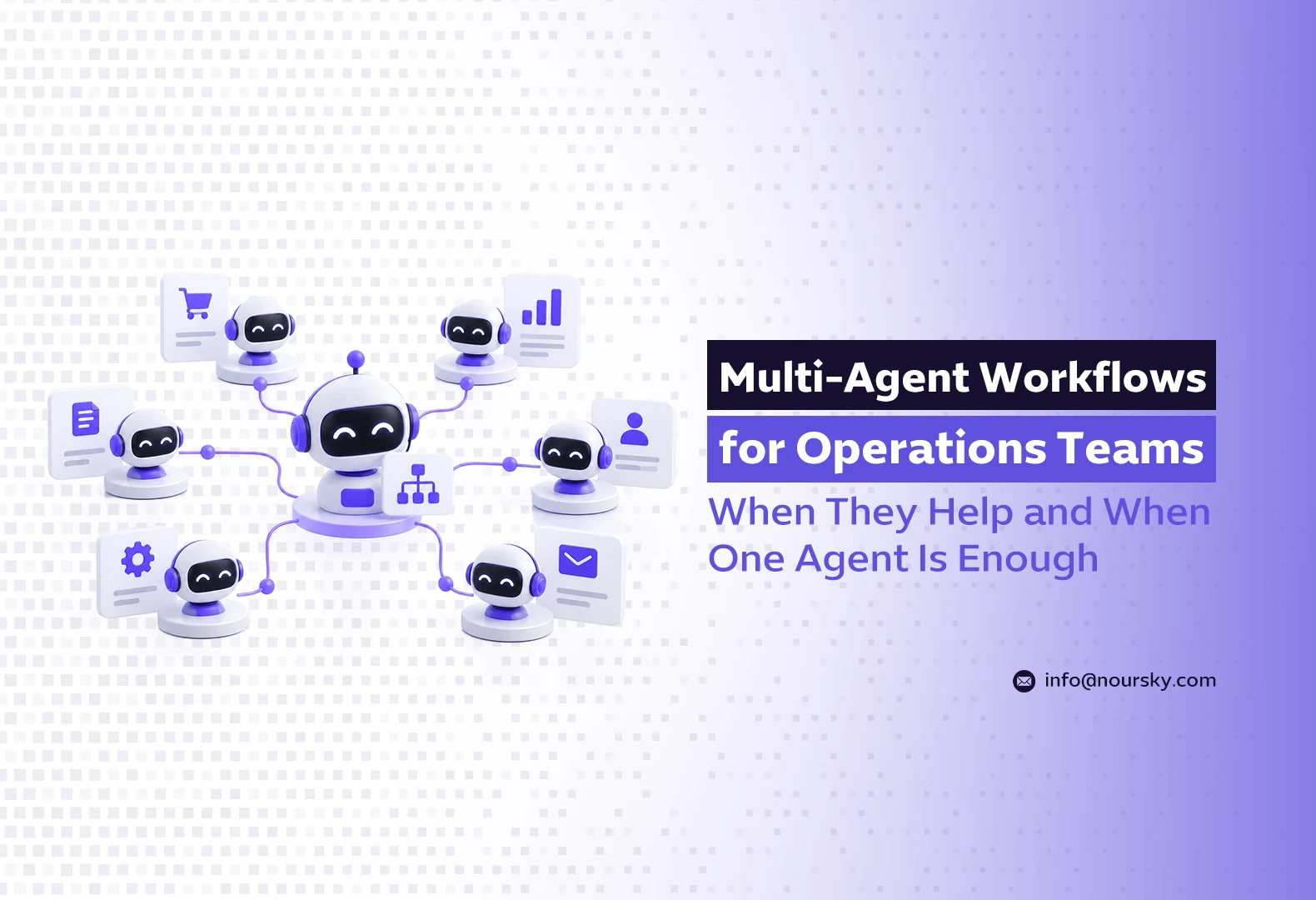
A multi-agent workflow combines the two. The most common shape is what Anthropic calls orchestrator-workers: “a central LLM dynamically breaks down tasks, delegates them to worker LLMs, and synthesizes their results.”
In an operations context, that could look like this (an illustrative example, not a client project):
| Agent | Role | Tools it can touch |
|---|---|---|
| Orchestrator | Reads the incoming request, decides which specialists to call, assembles the final output | None directly; it calls other agents |
| Intake agent | Extracts structured fields from an email, WhatsApp message or PDF | Document parser, CRM read |
| Policy agent | Checks the request against written rules (approval limits, SLAs) | Policy knowledge base |
| Data agent | Pulls order, stock or customer history | ERP / CRM read-only API |
| Drafting agent | Prepares the reply or the ticket update | CRM write (draft only) |
| Human approver | Approves anything with financial or customer-facing impact | Everything, with audit trail |
The last row is not optional. It is the part most “agent team” demos leave out.
Is a multi-agent system better than a single agent?
Sometimes, and the evidence says the answer depends on the shape of the task.
Anthropic published measurements from its own multi-agent research system in June 2025. A multi-agent setup with Claude Opus 4 as lead and Claude Sonnet 4 as subagents outperformed single-agent Claude Opus 4 by 90.2% on Anthropic’s internal research evaluation. That is a large gain, but it came with a cost the same article states plainly:
- Agents use roughly 4× more tokens than chat interactions.
- Multi-agent systems use roughly 15× more tokens than chat.
- In their analysis, token usage alone explained 80% of the performance variance on the BrowseComp evaluation.
In other words, much of the improvement came from spending more compute on the problem in parallel. Anthropic is explicit about where this does not fit:
“Some domains that require all agents to share the same context or involve many dependencies between agents are not a good fit for multi-agent systems today.”
And on coding specifically: “LLM agents are not yet great at coordinating and delegating to other agents in real time.”
So the honest rule for operations teams is:
| Task shape | Better fit | Why |
|---|---|---|
| Many independent lookups that can run in parallel (e.g. checking 40 supplier quotes against a spec) | Multi-agent | Parallel work is where the extra tokens buy real speed and coverage |
| A fixed sequence with clear rules (e.g. invoice intake → match PO → flag mismatch) | Workflow with one agent at the fuzzy step | Predictable, cheap, easy to audit |
| A conversation with one customer | Single agent with tools | Shared context matters more than parallelism |
| High-stakes decisions (refunds, credit, hiring) | Agent drafts, human decides | Accountability stays with a person |
Why do multi-agent AI systems fail?
The most detailed public evidence is a research paper on arXiv, Why Do Multi-Agent LLM Systems Fail? (Cemri et al., first posted March 2025). The authors analysed more than 1,600 annotated traces across 7 multi-agent frameworks and identified 14 distinct failure modes grouped into 3 categories:
- System design issues: agents that disobey the task or role specification, repeat steps, lose conversation history, or are unaware of stopping conditions.
- Inter-agent misalignment: conversation resets, failing to ask for clarification, task derailment, information withholding, ignoring another agent’s input, and reasoning that doesn’t match the action taken.
- Task verification: premature termination, no or incomplete verification, and incorrect verification.
The annotators reached an inter-annotator agreement of kappa = 0.88, so these categories are not a matter of taste. For an operations team, the takeaway is practical: most failures are design and verification failures, not model failures. Better prompts help, but clearer roles and a real checking step help more.
The business-level picture matches. Gartner predicted in June 2025 that over 40% of agentic AI projects will be canceled by the end of 2027 due to escalating costs, unclear business value or inadequate risk controls. Gartner also estimated that only about 130 of the thousands of vendors claiming agentic capabilities are real, calling the rest “agent washing”. Anushree Verma, Senior Director Analyst at Gartner, put it directly:
“Most agentic AI projects right now are early stage experiments or proof of concepts that are mostly driven by hype and are often misapplied.”
The same release forecasts that by 2028, 33% of enterprise software applications will include agentic AI (up from less than 1% in 2024), and 15% of day-to-day work decisions will be made autonomously through agentic AI. The direction is clear; the failure rate on the way there is also clear.
How should an operations team design its first multi-agent workflow?
Anthropic’s first recommendation applies before anything else: “We recommend finding the simplest solution possible, and only increasing complexity when needed.” Here is a step list we would follow:
- Pick one process with a measurable pain. Hours per week spent, backlog size, error rate or response time. If you cannot measure it today, you will not know if the agents helped.
- Map it as a plain workflow first. Write every step, input, decision and owner. Many “agent” problems turn out to be a missing rule or a missing integration.
- Mark which steps are fuzzy. Reading a messy email is fuzzy; checking an amount against a limit is not. Put AI only at the fuzzy steps and keep deterministic code for the rest.
- Only split into multiple agents where work is parallel. If step 3 needs the output of step 2, a second agent adds cost and a new failure point without adding speed.
- Give each agent the minimum tools. Read-only by default. Write access only for drafts. Nothing that moves money without a human.
- Build the verification step as its own role. Given the failure research above, the checker is where reliability comes from. It compares output against the source data and the written policy.
- Log everything. Every agent call, input, output and tool action, so a human can reconstruct what happened.
- Budget tokens up front. With multi-agent runs at roughly 15× the tokens of chat (per Anthropic), estimate the cost per completed task before you scale, not after.
- Run in shadow mode. Let the system produce outputs alongside your team for a few weeks. Compare, fix, then switch on.
What does this look like for teams in Saudi Arabia and the UAE?
A few regional specifics shape the design:
- Mixed-language inputs. Requests arrive in Arabic, English and mixed messages, often via WhatsApp. The intake step has to handle all three and normalise names, numbers and dates.
- Data protection. Saudi Arabia’s Personal Data Protection Law and the UAE’s federal data protection law both affect which data an agent may read and where it is processed. Scope data access per agent, not per system. (This is not legal advice; confirm with your counsel.)
- Customer channels. If an agent’s output reaches customers on WhatsApp, Meta’s messaging rules on opt-in and templates apply to the final message, whichever agent drafted it.
For the prompt side of each agent, see our guide to AI agent prompt design.
Start with the process, not the agent count
NourSky maps one of your operational processes, marks where AI actually helps and where plain automation is enough, and builds the smallest system that does the job, with a human approving anything that matters. No promise of headcount savings, just a system you can measure.
FAQ
What is the difference between a multi-agent workflow and a single AI agent?
A single agent handles the whole task with one set of instructions and tools. A multi-agent workflow splits the task across specialised agents coordinated by an orchestrator. The split helps when parts of the task can run in parallel, and hurts when every step depends on the previous one.
Are multi-agent systems more expensive to run?
Usually, yes. Anthropic reported that its multi-agent research system used roughly 15 times more tokens than a chat interaction, versus about 4 times for a single agent. The extra cost is worth it only when the task’s value justifies it.
Should an AI agent be allowed to approve refunds or payments?
Not on its own. Let agents gather data, check it against policy and draft the decision; keep approval of anything with financial or customer impact with a named person, with a full log of what the agents did.