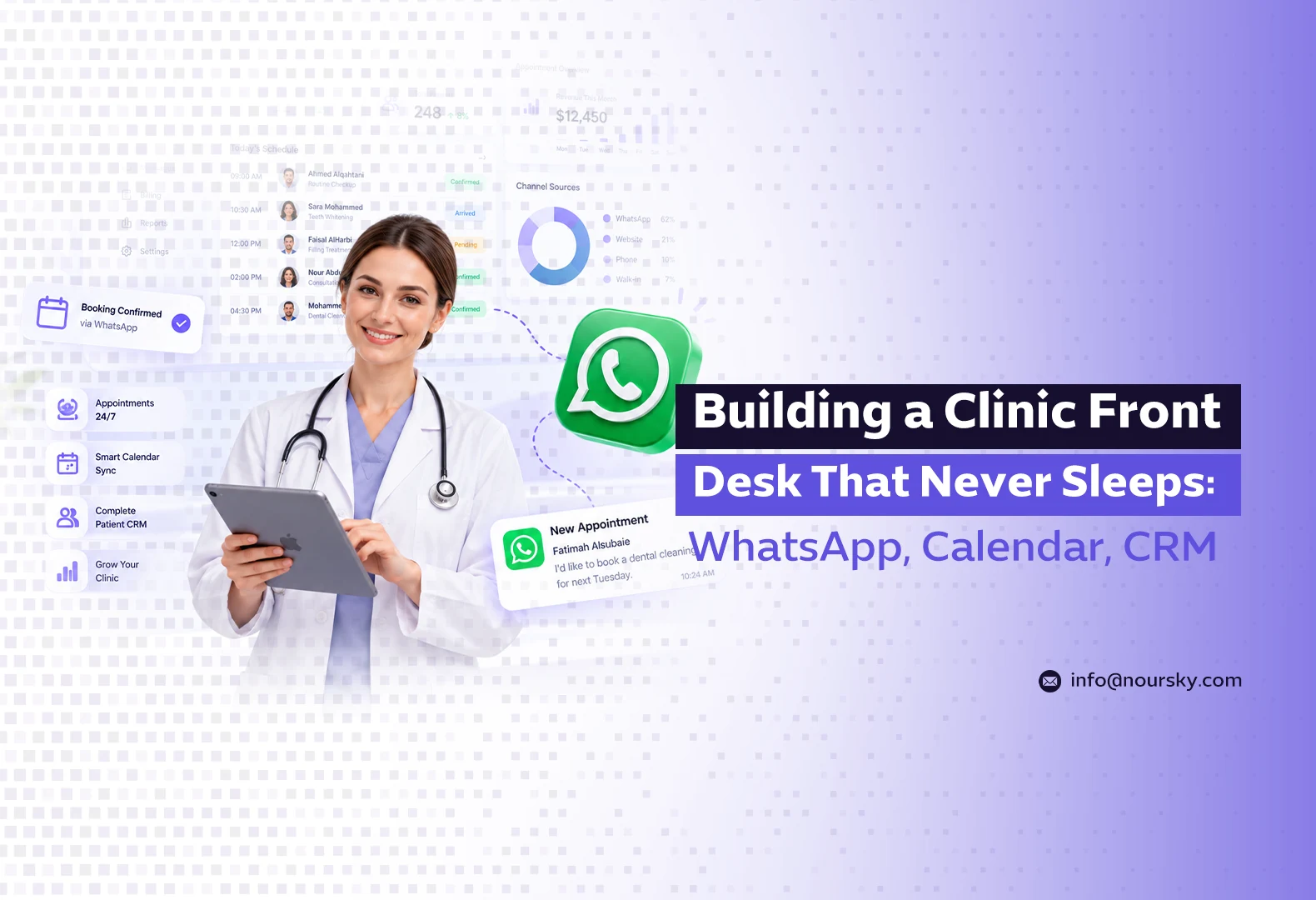
Clinic WhatsApp booking automation connects three things: the WhatsApp Business Platform, where patients ask; the clinic calendar, where real availability lives; and a CRM, where every patient’s stage is tracked. Built properly, it answers booking requests at any hour, books the right slot with the right doctor, sends reminders with a reschedule option, refills cancellations from a waitlist and hands urgent or clinical questions to staff immediately.
This guide is for clinic owners and practice managers in Saudi Arabia and the UAE whose front desk lives on WhatsApp. It covers the architecture, the flows and the rules, in the order we would build them. If you want to see how NourSky applies this to healthcare practices, start with NourSky for clinics.
Why does the front desk break after hours?
Most clinics don’t have a booking problem during the day. They have one at 10 p.m., on Fridays and during the Monday-morning rush, when a receptionist is answering the phone, checking in a patient and replying to twenty WhatsApp chats at once.
The cost shows up as missed appointments as much as missed bookings. A 2026 study in the Saudi Journal of Health Systems Research of primary-care dental clinics in the Jeddah First Health Cluster counted 886 no-shows in five days against roughly 7,200 weekly appointments, about 11%. Among 381 patients who had missed appointments, the most-cited reasons were transportation difficulties (24.9%), forgetting the appointment (13.4%) and time conflicts (9.2%).
Two of those three are exactly what a well-built reminder and self-service reschedule flow addresses.
Do automated reminders actually reduce no-shows?
The strongest evidence says yes. A Cochrane systematic review (Gurol-Urganci et al., 2013) pooled 8 randomised controlled trials with 6,615 participants. Its authors concluded that there was “moderate quality evidence” that “mobile text message reminders improved the rate of attendance at healthcare appointments compared to no reminders.”
In the included trials, attendance was 67.8% with no reminder, 78.6% with text reminders and 80.3% with phone-call reminders. Text and call reminders performed similarly, and two studies found the cost per attendance of a text reminder was 55% and 65% lower than a phone call.
For a clinic, that means an automated reminder gets you close to what a receptionist’s call achieves, without taking the receptionist off the desk.
What does the architecture look like?
| Layer | Job | Notes |
|---|---|---|
| WhatsApp Business Platform (API) | Receives and sends messages | Not the WhatsApp Business app on one phone |
| AI agent | Understands the request, asks the right questions, answers from clinic data | Trained on services, durations, branches, policies |
| Calendar / practice system | Source of truth for availability | Per doctor, per procedure duration |
| CRM | Patient stage, reminders, waitlist, follow-ups | Where the manager sees the whole funnel |
| Human handoff | Urgent, clinical, insurance, complaints | Routed to the right staff member with context |
The rule that holds this together: the agent never invents availability. It reads it from the calendar and writes the booking back.
How do you build clinic WhatsApp booking automation, step by step?
- Map services to durations and providers. A check-up is not a root canal. Each service needs a duration, the doctors who perform it and the branches that offer it. Without this table, automation books the wrong slot faster.
- Connect the calendar two ways. Read free slots; write confirmed bookings; listen for cancellations made at reception.
- Design the booking conversation. Ask only what you need: service, branch, preferred day and time, name. Offer two or three real slots, not an open question.
- Use WhatsApp Flows where a form beats a chat. Meta describes Flows this way: “With WhatsApp Flows, you can build interactive messages for users to complete actions directly on WhatsApp.” A branch-date-time picker inside the chat reduces back-and-forth.
- Write and approve reminder templates. According to Meta’s documentation, a 24-hour customer service window opens when the patient messages you; once it closes, “you can only send pre-approved template messages.” A reminder sent the day before an appointment booked last week is a template, so it must be written and approved in advance.
- Add confirm and reschedule buttons. A patient who reschedules is not a no-show. Make rescheduling one tap.
- Build the waitlist. When someone cancels, the CRM offers the slot to patients waiting for an earlier appointment.
- Define handoff rules. Severe pain, swelling, bleeding, anything clinical, insurance approvals and complaints go to a human immediately, with the conversation attached.
- Track the funnel. Requests received, booked, confirmed, attended, no-show, rescheduled. Review weekly.
How much does WhatsApp messaging cost a clinic?
Meta moved the WhatsApp Business Platform to per-message pricing on 1 July 2025. Per Meta’s pricing documentation, all non-template messages sent inside an open customer service window are free, and utility templates sent within an open window are also free. Marketing, utility and authentication templates sent outside the window are charged by category and country.
In practice: answering a patient who just messaged you costs nothing in Meta fees; the reminder you send a week later does. Check Meta’s current rate card for Saudi Arabia and the UAE before you budget.
What should stay human at the front desk?
| Situation | Agent | Human |
|---|---|---|
| “Do you have an appointment Thursday evening?” | Books it | — |
| “How much is a cleaning?” | Answers from the published price list | — |
| Reminder, confirmation, reschedule | Handles it | — |
| “My face is swollen and I’m in pain” | Flags as urgent, hands off at once | Clinical triage |
| Insurance eligibility or prior approval | Records that the patient will use insurance | Checks through the practice system |
| Complaint about treatment or billing | Hands off at once | Resolves |
How do you handle patient data safely?
In Saudi Arabia, the Personal Data Protection Law treats data “related to the health of an individual” as sensitive data, according to SDAIA’s guide to the law, which came into force on 14 September 2023. The same guide states: “You must not collect more personal data than you need to achieve the purpose of processing of personal data.”
For a booking flow, that translates into three design rules:
- Collect name, number, service and slot. Leave clinical history for the consultation room.
- Restrict who at the clinic can read WhatsApp transcripts in the CRM.
- Keep insurance processing in the system connected to NPHIES, the national health-insurance exchange, not in chat.
This section is general information, not legal advice. Confirm your obligations with SDAIA and the relevant health authority. Clinics in the UAE should check the applicable federal and emirate-level health data rules.
For the broader picture of how AI agents run on WhatsApp beyond healthcare, read AI Agent for WhatsApp Business: How It Works and What It Takes to Run. To estimate how many bookings slow replies may cost you, try the lost-leads calculator.
See a front desk that books while your clinic is closed
NourSky builds clinic WhatsApp booking automation for practices in Saudi Arabia and the UAE: an AI agent that books into your real calendar, sends reminders, refills cancellations and hands urgent cases to your team, with a CRM that tracks every patient’s stage.
FAQ
Can WhatsApp booking automation connect to our existing practice system?
Usually, if the system exposes its calendar through an API or a supported integration. If it doesn’t, the booking layer can manage a shared calendar that reception mirrors, though a two-way connection is always preferable.
Do we need the WhatsApp Business API, or is the WhatsApp Business app enough?
For automated booking and reminders you need the WhatsApp Business Platform (API). The app is built for staff replying by hand; it offers fixed greeting, away and quick-reply messages, but no connection to your calendar or CRM and no approved template messaging.
Will patients know they are talking to an AI agent?
They should. Say so in the first message and always offer a clear path to a person. Patients mainly care that the booking is correct and that urgent issues reach a human fast.