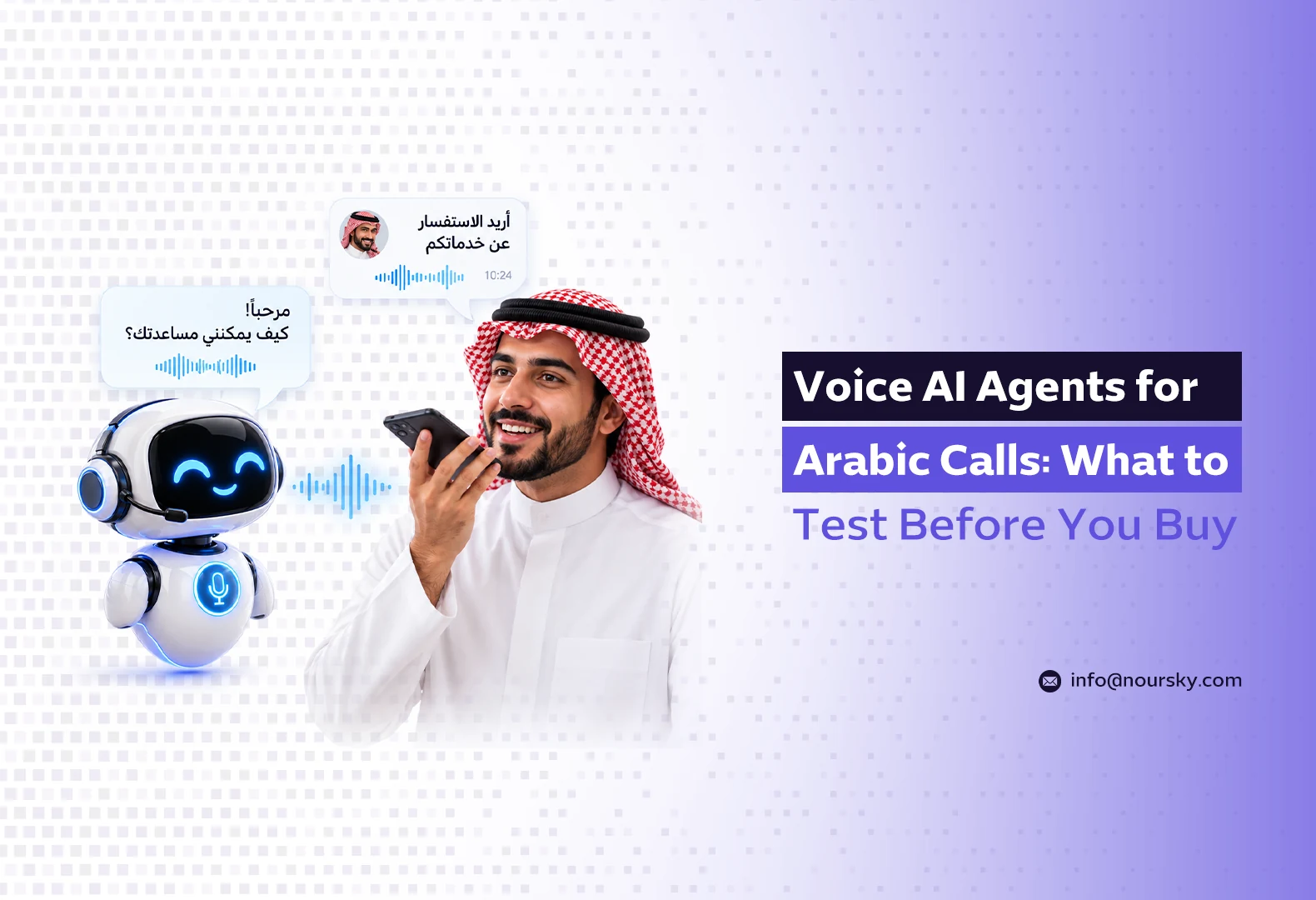
Before you buy an Arabic voice AI agent, test it on your own recorded calls, not the vendor’s demo. Measure five things: accuracy on your customers’ dialect, performance with background noise, response delay, how it handles interruptions, and how cleanly it hands the call to a human. Published benchmarks show Arabic speech recognition drops sharply outside Modern Standard Arabic.
This guide is for business owners and operations managers in Saudi Arabia and the UAE who are being pitched voice agents for inbound or outbound calls. NourSky builds AI Employees that answer customers in writing on WhatsApp; this article is about the voice channel, where the failure modes are different and far less forgiving.
Why is Arabic voice harder than Arabic text?
A text agent reads exactly what the customer typed. A voice agent first has to hear it: automatic speech recognition (ASR) turns audio into text, a language model decides what to say, and a text-to-speech engine speaks the reply. Every stage adds error and delay, and errors compound. If ASR mishears a district name or a number, the smartest language model in the world will answer the wrong question confidently.
Arabic adds a specific problem: most customers do not speak Modern Standard Arabic (MSA) on the phone. They speak Najdi, Hijazi, Khaliji, Egyptian or a mix, often switching into English for product names.
What do published benchmarks say about Arabic dialect recognition?
Two recent academic benchmarks are worth reading before any vendor meeting.
The Open Universal Arabic ASR Leaderboard (Wang, Alhmoud and Alqurishi, 2024) evaluated open-source Arabic ASR models across multi-dialect datasets. Its authors report that “all models achieve their best results on MSA, but exhibit a significant decline when applied to dialects such as Egyptian and Khaliji.” For the top-ranked model (Nvidia’s Conformer-CTC-large with a 4-gram language model, 25.71% average word error rate), the dialect-level word error rates were:
| Dialect (SADA subset) | Word error rate, top-ranked open model |
|---|---|
| MSA | 19.23% |
| Najdi | 36.34% |
| Hijazi | 36.96% |
| Egyptian | 40.97% |
| Khaliji | 48.23% |
In plain terms: on Khaliji speech, the best open model in that benchmark got nearly one word in two wrong. The paper also notes that “under Noisy or Music environments, all models show a certain degree of performance degradation compared to the Clean environment.”
SADA (Saudi Audio Dataset for Arabic), a corpus of 668 hours of audio drawn from Saudi television shows, was benchmarked in a 2025 paper. The best configuration reported, an MMS 1B model fine-tuned on SADA with a 4-gram language model, reached 40.9% word error rate on the clean test set.
Two caveats matter. These are open-source models, and commercial vendors may use stronger proprietary systems. And word error rate on TV speech is not the same as task success on a booking call. But the direction is clear and consistent: dialect and noise are where Arabic voice systems break, so that is exactly where your test must push.
How fast does a voice agent need to respond?
Human conversation is fast. Summarising a much-cited cross-language study, cognitive scientist Antje Meyer writes in the Journal of Cognition (2023) that Stivers and colleagues (2009) “examined the gaps between yes/no questions and the following answers in ten languages and found median gap durations between 0 ms and 300 ms.”
A voice agent that pauses for a second or two after every sentence does not feel like a slow person; it feels like a broken line. Customers start talking again, the agent starts answering the first thing they said, and the call derails. Measure the delay yourself, from the moment the caller stops speaking to the first audible word of the reply, across many turns, not one.
What should you test before you buy? A 7-step plan
- Record 30–50 of your own real calls (with the consent and notices your legal adviser requires). Include your most common dialects, older callers, callers on speaker in cars, and calls with children or street noise in the background.
- Build a script of the 20 things callers actually ask, in their words: prices, availability, locations, “I want to change my appointment”, numbers, dates and neighbourhood names.
- Test recognition on names and numbers first. Ask the vendor to show you the transcript of each test call. Phone numbers, national ID lengths, prices and district names are where a single misheard word becomes a wrong booking.
- Test interruptions (barge-in). Interrupt the agent mid-sentence with a correction (“no, Thursday, not Tuesday”). Does it stop and adjust, or finish its sentence and ignore you?
- Measure response delay on at least 20 turns and look at the slowest ones, not the average.
- Test the handoff. Ask for a human three different ways, including angrily. Check that the human receives the transcript and the collected details, so the caller doesn’t repeat themselves.
- Test the “I don’t know” path. Ask something outside the knowledge base. A good agent says it will transfer or call back. A bad one invents an answer.
How do vendors compare on the things that matter?
Use this as a scoring sheet during demos. Fill it with what you observed, not what the sales deck claims.
| Test | What “good” looks like | Red flag |
|---|---|---|
| Dialect accuracy | Transcripts of your calls are readable; names and numbers correct | Vendor only demos MSA or scripted speech |
| Noise | Works with car and street noise at acceptable quality | Demo recorded in a quiet studio only |
| Latency | Consistently short pauses across many turns | Long, variable pauses; talk-over |
| Interruptions | Stops and adapts to corrections | Finishes its sentence regardless |
| Handoff | Transfer on request, with transcript and details passed on | Loops the caller through more questions |
| Unknown questions | Admits limits, transfers or books a callback | Improvises prices or policies |
| Data handling | Clear answers on where audio and transcripts are stored and for how long | Vague answers; no written data terms |
Do customers actually want to talk to AI?
Be honest with yourself here. A Gartner survey of 5,728 customers (December 2023, published July 2024) found that 64% would prefer companies didn’t use AI for customer service, and 53% would consider switching to a competitor if a company did. The top concern was that it would become harder to reach a person.
Gartner’s newer survey of 3,566 customers (February–March 2026) found that 87% say companies using GenAI for customer service must provide access to a human agent. Eric Keller, Senior Director Analyst in Gartner’s Customer Service & Support practice, put it directly:
“Service leaders should not use GenAI as a mandatory first step for every issue.”
For voice, that means the human route must be one short sentence away, on every call.
What about recordings and personal data in Saudi Arabia?
Every voice agent records or transcribes calls, and both contain personal data. According to SDAIA’s guide for controllers and processors, Saudi Arabia’s Personal Data Protection Law came into force on 14 September 2023, with a one-year grace period for compliance, and “a Controller must ensure that the Processor(s) it engages fully complies with the PDPL.” Ask any vendor, in writing, where audio and transcripts are stored, who can access them, and how long they’re kept. This is general information, not legal advice; confirm your obligations with a qualified adviser.
Should you start with voice or with WhatsApp?
If most of your enquiries already arrive in writing, start there: text removes the recognition layer entirely, and the customer can read, scroll back and send a location pin. Voice makes sense when callers genuinely won’t type, and only after the test above passes on your own calls. For a clear-eyed look at costs on the text side, read AI Employee vs Hiring a Sales Assistant: The Real Cost in the Gulf.
Test an AI Employee on your real customer questions
NourSky builds AI Employees for businesses in Saudi Arabia and the UAE that answer on WhatsApp, qualify the enquiry and log it in your CRM, with a clear handoff to your team. Bring your 20 most common questions and see how it handles them.
Request a live demo → · or first estimate what slow replies cost you →
FAQ
Can an Arabic voice AI agent understand Saudi and Gulf dialects?
It depends heavily on the system. In the Open Universal Arabic ASR Leaderboard (2024), the top open model’s word error rate rose from 19.23% on MSA to 48.23% on Khaliji speech. Test any vendor on recordings of your own customers.
What response delay is acceptable for a voice agent?
Human turn gaps are short: a ten-language study summarised in the Journal of Cognition (2023) found median gaps between 0 and 300 ms. Measure the agent’s delay across many turns and pay attention to the slowest ones.
What is the single most important test before buying?
The handoff. Ask for a human in several ways and confirm the call transfers quickly with the transcript and collected details, so the customer never repeats themselves.